Call for Papers
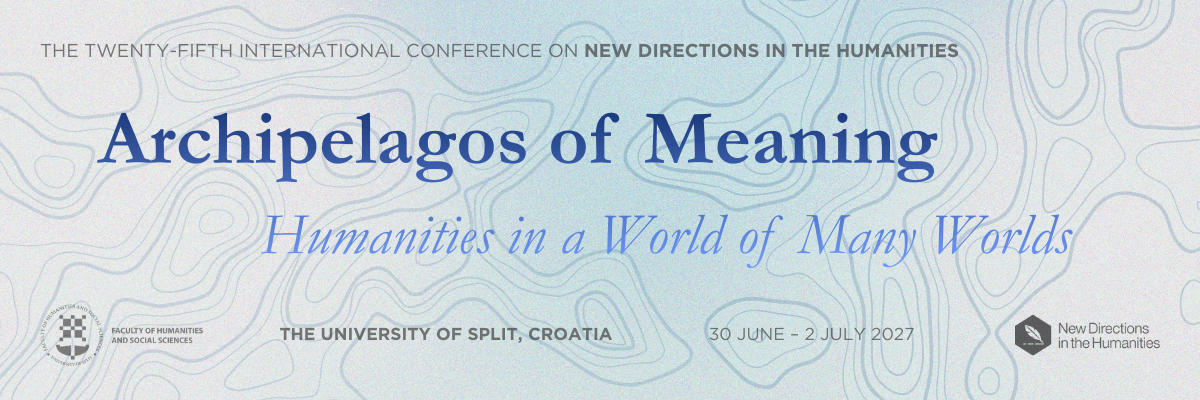
We warmly invite you to participate in the Twenty-Fifth International Conference on New Directions in the Humanities, the annual conference of the New Directions in the Humanities Research Network, hosted by the University of Split, Croatia, and convened from 30 June to 2 July 2027, with online participation available.
Marking a quarter-century of inquiry, this conference reflects on the enduring role of the humanities in interpreting, critiquing, and reimagining the human condition. Over twenty-five years, the conference has brought together scholars, educators, and practitioners to explore how meaning is formed across culture, language, knowledge, and public life.
This year’s theme, Archipelagos of Meaning, takes the archipelago as a way of thinking about how humanistic inquiry moves across plural and interconnected worlds. Islands and mainland, urban centres and rural regions, institutions and everyday life form distinct yet related sites of meaning. The humanities help us read these worlds in relation: attending to their stories, symbols, tensions, and practices of sense-making.
Hosted by the University of Split, the conference is shaped by the Adriatic context, its coastal cities and island networks, its histories of exchange, and its contemporary intersections of education, labour, tourism, and environmental change. This setting invites reflection on connection and difference, mobility and belonging, memory and future-making.
Themes
Proposals are welcomed across the breadth of humanities scholarship, including but not limited to the following sub-themes:
Engaged Humanities, Citizenship, and Democratic Culture: Humanistic inquiry as an engaged social practice, including citizenship education, critical thinking, civic engagement, leadership, and democratic cultures within educational and public institutions.
Language, Power, and Meaning-Making: Language, discourse, and ideology in contemporary communication, including multimodal meaning-making, audience reception, interpretation, and the politics of representation.
Literature, Narrative, and Cultural Imagination: Literature and storytelling as bearers of social and cultural meaning, shaping identities, memory, values, and collective futures across diverse communities.
Technologies of Communication: AI, Media, and Interpretation: Humanistic perspectives on digital media and artificial intelligence, including language technologies, authorship, ethics, bias, creativity, and changing communicative practices.
Place, Community, and Sustainable Futures: Sociality in space, including urban–rural relations, polycentric development, island communities, climate change, environment, and sustainability as cultural and ethical challenges.
Format
The conference is organised as a hybrid knowledge experience, integrating in-person and online participation within a unified scholarly environment. All accepted proposals become Presentation Pages, where presenters upload abstracts, media, and reflections, and where delegates engage in discussion before, during, and after the event.
In-person presentations in Split, live online sessions, and asynchronous contributions are woven together into a single integrated program. Regardless of participation mode, all delegates have access to the full schedule, session media, and a growing digital archive.
Across all formats, the emphasis is on reciprocal, human-scale scholarly exchange—conversation, reflection, and collaborative inquiry rather than one-directional presentation.
Publication Pathways
Presenters are invited to develop their conference contributions for possible publication in the journals and book imprints of the New Directions in the Humanities Research Network, which support a broad range of humanistic inquiry. All outlets offer options for both traditional and Open Access publication.
We look forward to welcoming you to a thoughtful, collegial, and dialogic gathering—whether in Split or online.
Sincerely,
Toni Popović, Local Conference Chair, Assistant Professor, University of Split, Croatia
Ivana Petrović, Local Conference Committee, Associate Professor, University of Split, Croatia
Ljudevit Hanžek, Local Conference Committee, Assistant Professor, University of Split, Croatia
Maja Bezić, Local Conference Committee, Associate Professor, University of Split, Croatia
Renata Relja, Local Conference Committee, Professor, University of Split, Croatia
Marita Brčić Kuljiš, Local Conference Committee, Professor, University of Split, Croatia
Tea Gutović, Local Conference Committee, Assistant Professor, University of Split, Croatia
Tanja Brešan Ančić, Local Conference Committee, Associate Professor, University of Split, Croatia
Nikša Varezić, Local Conference Committee, Associate Professor, University of Split, Croatia
Dr. Asun López-Varela, Research Network Chair, Universidad Complutense de Madrid, Madrid, Spain
Dr. Phillip Kalantzis-Cope, Chief Social Scientist, Common Ground Research Networks, United States of America